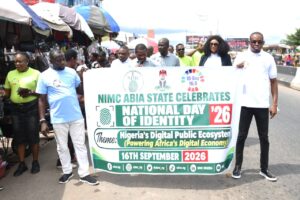
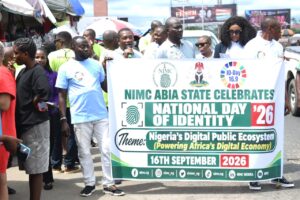
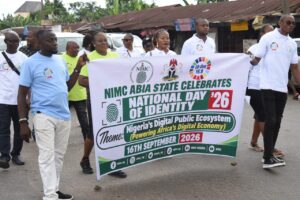
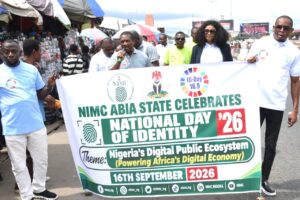
The National Identity Management Commission (NIMC), Abia State, has taken its National Identification Number (NIN) enlightenment campaign to major streets and open spaces across the state, urging Nigerians to obtain and properly use their national identity credentials as a gateway to essential services and participation in the digital economy.


The campaign formed part of activities marking the 2026 National Identity Day, celebrated on Wednesday, September 16, with the theme, “Nigeria’s Digital Public Ecosystem — Powering Africa’s Digital Economy.”
Speaking shortly after the exercise, the NIMC State Coordinator in Abia, Mr. King Ukpabi said the campaign was designed to sensitise citizens to the importance of national identity and promote greater awareness of the benefits of obtaining the NIN.



Sir King Ukpabi said the initiative was aligned with United Nations Sustainable Development Goal 16.9, which seeks to provide legal identity for all, including birth registration, by 2030.
He noted that Nigeria had demonstrated its commitment to the global identity agenda by designating September 16 as National Identity Day, stressing that a functional identity system was essential to effective national planning, inclusion and good governance.




According to him, the NIN plays a significant role in national development by helping government plan effectively and ensuring that citizens are appropriately captured for access to government services, social interventions and other opportunities.


He further encouraged Nigerians to obtain their NIN, noting that having a verifiable national identity could facilitate access to essential government services, palliatives and employment opportunities.
Delivering the keynote address at the Identity Day event, Lady Gloria Abiakam Ify, Chairman of the Association of Heads of Federal Establishments (AHFE), Abia State, and Federal Head, Federal Ministry of Information and National Orientation, described identity as the foundation of Nigeria’s digital future and a critical infrastructure for economic and social development.




Speaking on the theme, “Nigeria’s Digital Public Ecosystem — Powering Africa’s Digital Economy,” Abiakam said the significance of identity had gone beyond possession of an identity number or document, stressing that a trusted digital identity could connect citizens to opportunities, services and economic participation.
She explained that reliable digital identity systems could facilitate access to financial services, healthcare, education, employment and government programmes while supporting a more efficient and accountable public sector.



According to her, “identity is infrastructure,” just as roads connect communities and electricity powers industries, because a trusted identity system connects citizens to services and opportunities.
She said Nigeria was already experiencing rapid digital transformation, with businesses, financial services, government operations, education, healthcare, transportation and commerce increasingly adopting digital platforms.
However, she cautioned that technology alone could not guarantee inclusion, stressing that the success of digital transformation should ultimately be measured by how many Nigerians were able to benefit from it.
Lady Abiakam called for a digital public ecosystem that was accessible, secure, trusted and citizen-centred, stressing the need for identity, payments, social protection, taxation, business registration, healthcare, education and other public services to increasingly work together securely and efficiently.



She said such integration would reduce duplication, improve efficiency and make government services more responsive, noting that citizens should not be subjected to unnecessary repetition in proving their identity where government systems could securely verify the information.
The Federal Information Head, however, identified digital exclusion, inadequate connectivity, low digital literacy, cybersecurity threats, identity theft, fraud and data privacy concerns as some of the challenges that must be addressed as Nigeria expands its digital ecosystem.
She stressed that security must go hand-in-hand with innovation, urging government institutions, technology companies and service providers to uphold strong standards of data protection, cybersecurity, authentication and responsible data governance.




Abiakam also linked digital inclusion to economic empowerment, particularly for Nigeria’s youthful population, noting that technology, creative industries, e-commerce, fintech, agriculture, education and professional services offered significant opportunities for economic participation.
She urged the government, private sector, technology companies, financial institutions, telecommunications providers, innovators and development partners to deepen collaboration in developing digital solutions that address Nigeria’s specific needs.
She equally charged young Nigerians to see themselves not merely as users of technology but as builders of the digital economy, urging them to use technology to solve problems, create jobs, build businesses and contribute to Africa’s digital transformation.
She said the Federal Ministry of Information and National Orientation had an important role in ensuring that digital transformation did not remain a conversation limited to experts and institutions, but was communicated in clear and accessible language to citizens across communities, schools, markets, workplaces and rural areas.
“Identity is more than a number. It represents recognition, belonging, access, dignity and opportunity,” Abiakam said, adding that a trusted identity could become the gateway through which millions of Nigerians participate in the formal economy and access essential services.
She urged stakeholders to build a digital Nigeria that leaves no one behind, where identity opens doors rather than creates barriers, technology makes government services faster and more transparent, and citizens can trust systems holding their personal information.



Also speaking, the Head of ICT and Technical Services, NIMC, Abia State, Mr. Nathaniel Nwamu, encouraged members of the public to download the NIMC NINAuth application, describing it as a useful tool for identity verification and authentication as well as facilitating registration and access to identity-related services.
The officials reiterated the importance of a trusted national identity ecosystem to Nigeria’s development, inclusion, effective governance and growing digital economy.





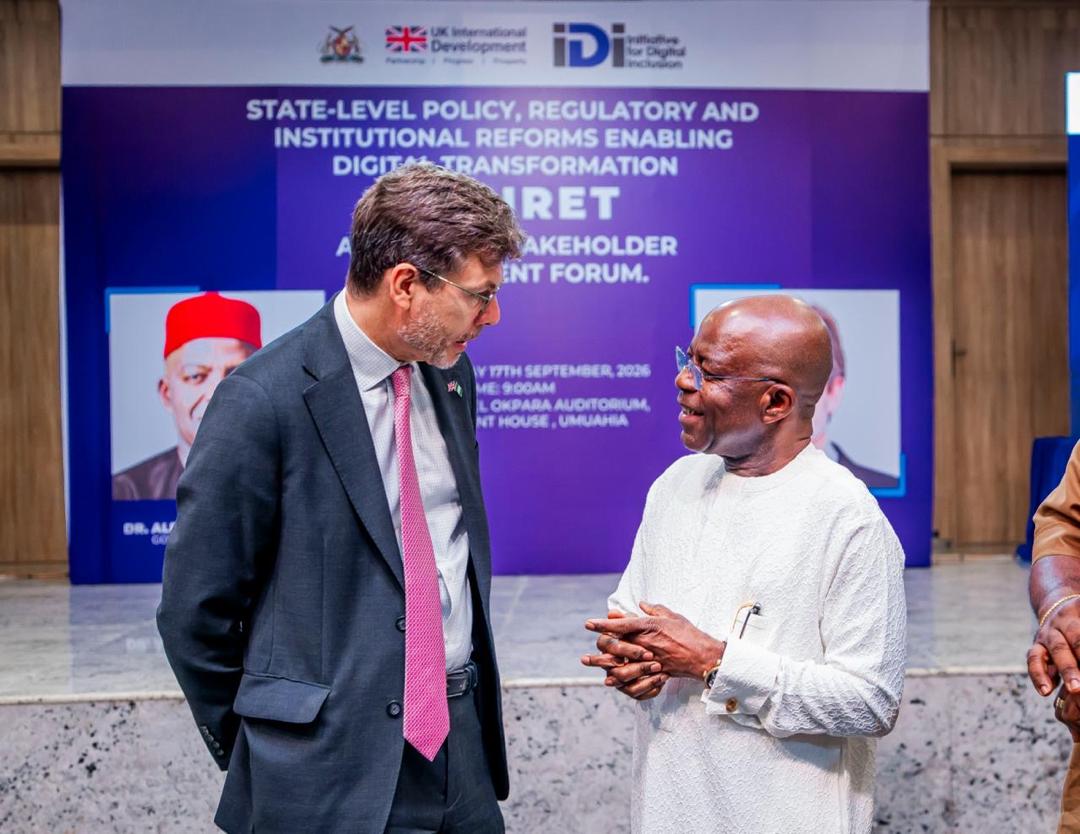
 Abia State Governor, Dr. Alex C. Otti, OFR, has called for stronger collaboration between government, the private sector and development partners to harness digital technology for economic growth, job creation and solutions to community challenges.